Best Microservices Telegram Groups (2026)
Discover the best Telegram groups for microservices, distributed systems, event-driven design, and API gateway architectures.
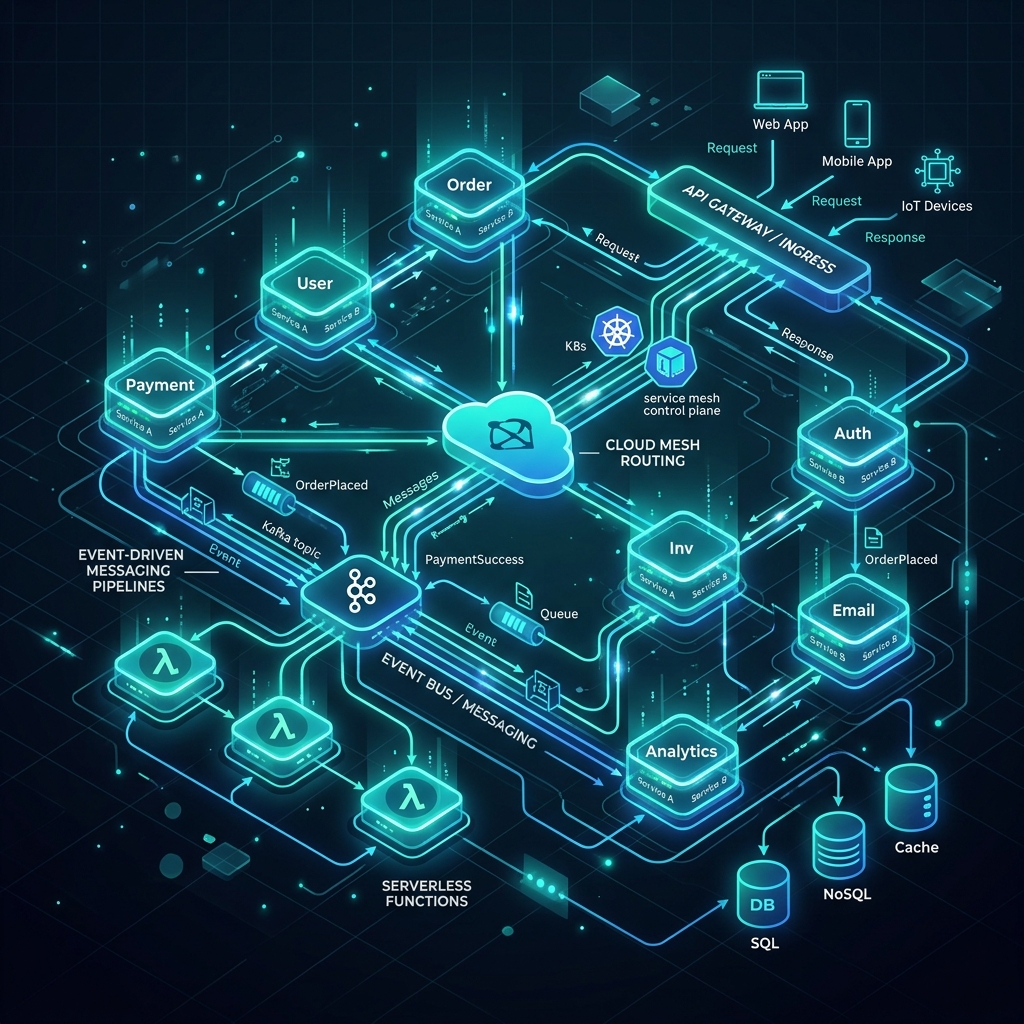
Building scalable distributed systems in 2026 demands deep architectural understanding, rapid consensus, and real-time knowledge sharing. Microservices have evolved from simple REST API decompositions into highly sophisticated, event-driven, cloud-native ecosystems powered by containers, gRPC messaging pipelines, and automated service meshes. Engineering teams transitioning from monolithic codebases to distributed microservices frequently face tough challenges: managing eventual consistency, implementing distributed tracing across dozens of services, maintaining API contracts, and orchestrating complex deployments without downtime.
Telegram has emerged as one of the most dynamic real-time communication platforms for software architects, backend engineers, DevOps specialists, and site reliability engineers (SREs). Unlike traditional forums where answers can take days to materialize, active engineering groups on Telegram offer peer-to-peer technical guidance, instant feedback on sequence diagrams, incident post-mortems, and live debugging support.
Whether you are designing a high-throughput financial clearing platform, implementing event sourcing with Apache Kafka, or tuning gRPC transport channels in Go and Rust, joining specialized developer groups accelerates your mastery of distributed infrastructure.
Real Database Microservices & Backend Communities
Below is a curated benchmark table highlighting top-rated engineering communities from our verified directory. These groups connect thousands of global backend developers, system architects, and cloud infrastructure specialists.
| Community Name | Telegram Handle | Member Count | Architectural Specialty | Community Directory Profile |
|---|---|---|---|---|
| Coders of Code | @codersofcode | 144,173 | High-Scale System Design & Microservices | Explore @codersofcode Directory Entry |
| Geek Gurus | @geekgurus | 132,680 | Cloud Native & Distributed Algorithms | Explore @geekgurus Directory Entry |
| Dev Developers Zone | @devdeveloperszone | 131,342 | Backend API Gateways & Event Pipelines | Explore @devdeveloperszone Directory Entry |
| Code Hackers | @codehackers | 127,689 | Security Hardening & Zero-Trust Mesh | Explore @codehackers Directory Entry |
| Architects of Node | @architectsofnode | 127,314 | Asynchronous I/O & Microservice Runtime | Explore @architectsofnode Directory Entry |
| Code Minds Network | @codemindsnetwork | 126,236 | Resilience Patterns & Saga Orchestration | Explore @codemindsnetwork Directory Entry |
Joining active communities featured in our Programming Telegram Category provides immediate access to seasoned engineers who share battle-tested solutions for distributed architectures. You can also filter groups by region and language using our English Language Index.
Crucial Distributed Architecture Patterns Discussed in Tech Hubs
Modern microservices applications rely on well-defined structural and behavioral design patterns. In active Telegram engineering groups, discussions often center around practical trade-offs when implementing these patterns in production environments.
API Gateway & Service Mesh Traffic Management
The API Gateway acts as the single point of entry for external client applications, encapsulating internal service boundaries and providing critical cross-cutting concerns. Key topics discussed in communities include:
- Centralized Authentication & Authorization: Offloading JWT validation, mTLS handshake termination, and OAuth2 scopes at the gateway boundary using tools like Envoy, Kong, or Traefik.
- Dynamic Rate Limiting & Throttling: Preventing cascading service overload by applying token bucket or leaky bucket algorithms at ingress proxies.
- Service Discovery & Load Balancing: Dynamically routing traffic across ephemeral container instances based on health checks, latency metrics, and round-robin scheduling.
- Protocol Translation: Converting external HTTP/2 or HTTP/3 REST and GraphQL requests into high-performance internal gRPC binary payloads over Protobuf.
When internal service counts grow into hundreds, developer groups frequently recommend migrating traffic control to a full service mesh like Istio or Linkerd. Service meshes inject sidecar proxies alongside each service instance, providing transparent mTLS encryption, automated telemetry collection, and traffic splitting for canary deployments without modifying application source code.
Event-Driven Architectures & Message Broker Topology
Decoupling services through asynchronous messaging is essential for achieving high throughput, fault tolerance, and loose coupling. Software architects in Telegram communities dive deep into messaging platforms and event patterns:
- Log-Based Streaming vs AMQP Queues: Comparing Apache Kafka and Redpanda event logs against RabbitMQ and NATS messaging primitives for transactional messaging versus real-time telemetry streams.
- Event Sourcing & CQRS (Command Query Responsibility Segregation): Persisting state changes as an immutable sequence of events to enable audited point-in-time replay and separated read/write data models.
- Idempotent Message Handlers: Designing consumer services with deduplication keys and transactional outbox patterns to guarantee at-least-once processing safety without duplicate mutations.
- Dead-Letter Queues (DLQ) & Retry Policies: Implementing exponential backoff, jitter, and poison-pill isolation to handle transient processing errors smoothly.
For official specification details on open event standards and cloud-native computing benchmarks, explore the CNCF Cloud Native Computing Foundation and the Kubernetes Documentation.
Distributed Transactions & The Saga Pattern
In a monolithic application, maintaining data consistency relies on ACID transactions managed by a single relational database engine. In microservices where each service owns its isolated database, traditional two-phase commit (2PC) protocols introduce blocking bottlenecks and availability risks.
Engineers in backend Telegram groups heavily favor the Saga Pattern for managing long-running distributed transactions across microservices:
- Choreography-Based Sagas: Each service involved in the business process listens to domain events published by preceding services and executes local transactions autonomously without a central orchestrator.
- Orchestration-Based Sagas: A dedicated Saga Orchestrator service commands participant services to perform local transactions and tracks overall process state using state machine engines like Temporal or Zeebe.
- Compensating Transactions: When a local transaction fails mid-workflow (such as a payment failure after inventory reservation), the orchestrator triggers explicit compensating actions in reverse order to roll back state changes smoothly.
Resilience Patterns & Circuit Breaking
Distributed systems must expect network partitions, hardware failures, and service degradation. Building resilient systems requires defensive engineering patterns:
- Circuit Breaker Pattern: Isolating failing upstream services by automatically tripping open when error thresholds are breached, preventing requests from piling up and exhausting thread pools.
- Bulkhead Pattern: Partitioning system resources (such as database connection pools or thread executors) so that a failure in one non-critical service does not starve critical business operations.
- Distributed Tracing & Telemetry: Propagating W3C Trace Context headers across HTTP and gRPC boundaries using OpenTelemetry to visualize end-to-end request latencies and locate bottlenecks in Jaeger or Zipkin.
To review foundational asynchronous runtime concepts and server-side I/O mechanics, consult the Node.js Documentation and GitHub Microservices Patterns.
How to Get maximum Value from Microservices Developer Groups
To transform your membership in Telegram tech communities into accelerated career growth and engineering mastery, adopt these proactive strategies:
- Share Architectural Sequence Diagrams: When asking for advice on complex service interactions, upload clean Mermaid.js or PlantUML sequence diagrams to convey workflow state quickly.
- Discuss Real Production Benchmarks: Benchmark messaging throughput, memory footprints, and p99 latency stats under simulated load testing rather than relying on theoretical claims.
- Participate in Incident Post-Mortems: Engage in discussions dissecting real-world outages. Analyzing how senior engineers debug memory leaks, DNS resolver failures, or thread pool starvations builds invaluable intuition.
- Stay Informed on Evolving Standards: Monitor emerging tech stacks including WebAssembly (Wasm) sidecars, eBPF network observability, and micro-framework optimizations in Go, Rust, and TypeScript.
Summary & Next Steps for Infrastructure Engineers
Navigating the complexities of microservices and distributed systems requires continuous learning and active collaboration. By joining top-tier Telegram communities, studying battle-tested design patterns, and leveraging verified directory resources like our Programming Telegram Directory, you position yourself at the forefront of modern software engineering.
Explore our directory categories today to connect with active developer channels, level up your architecture skills, and build robust cloud-native systems for tomorrow.
Want more Telegram insights?
Subscribe to our weekly newsletter for the fastest growing communities.
Use the form in the footer below! 👇